The Monad Economy: Eight Months In

Monad Foundation
@monad- Published on
- · 11 min read
Monad was built to enable open access to financial markets. Anyone with an internet connection and a wallet can get access to the same financial tools. No bank account or permission from a third party is required. A single dollar moved to Monad can be spent as a payment, lent through lending markets, borrowed against as collateral, or traded for a new asset without leaving the chain.
Since mainnet went live in November 2025, key financial primitives have arrived onchain and are forming a fast-growing economy. The numbers (as of the end of July, 2026) back this up:
- Total value locked (including borrows) has surpassed $1.4 billion while Total DeFi TVL has passed $770 million
- About 3.5 million transactions a day across over 150 applications
- Stablecoin market cap on Monad is over $550 million
- Tokenized real-world assets market cap exceeds $430 million
- Top 15 DEX trading volume among all chains
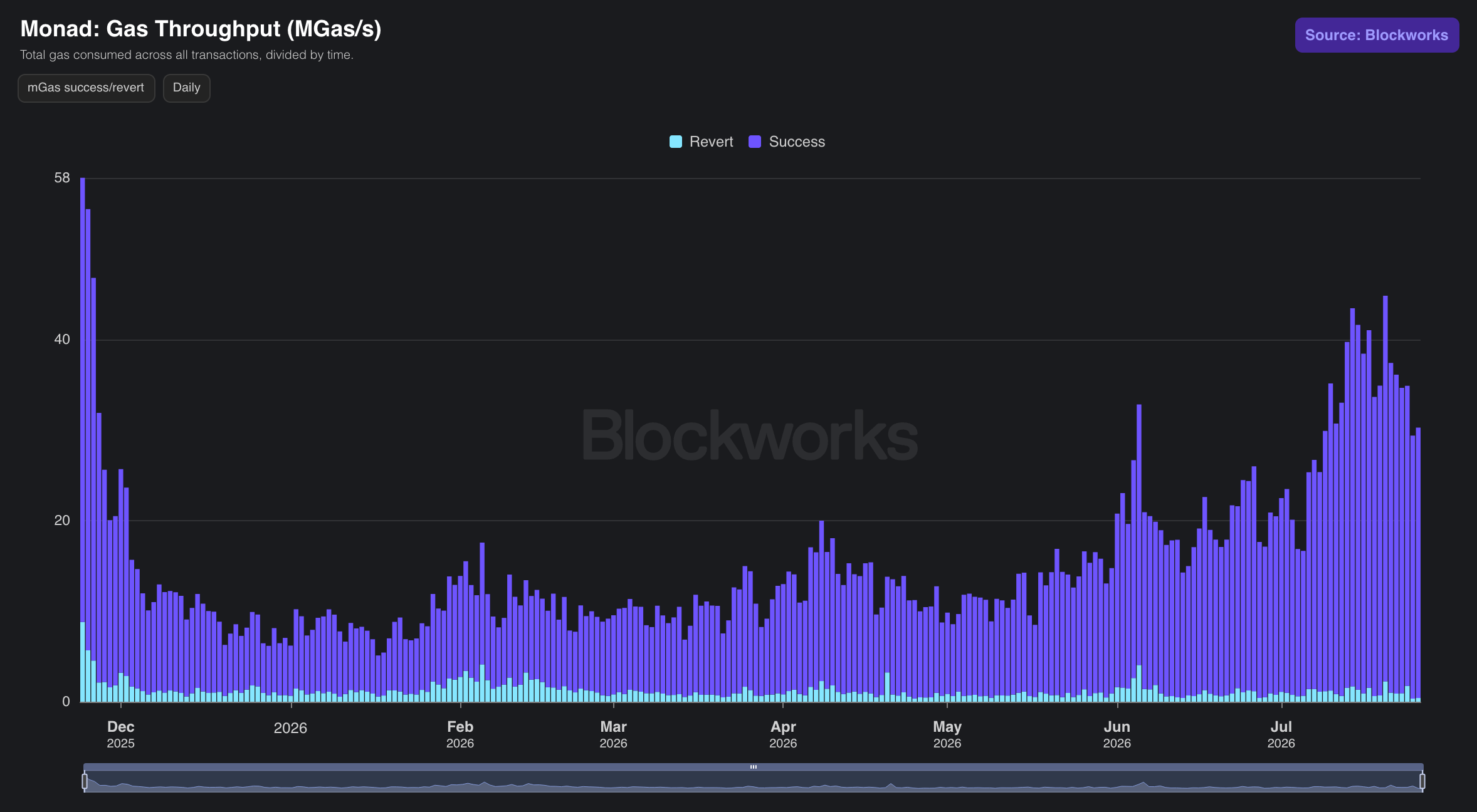
Total gas consumed is increasing steadily. Source: Blockworks.
These metrics all reinforce each other in a positive flywheel. Every dollar that comes onchain is usable across the entire economy. Payments and onramps bring capital in. Those balances become the liquidity DeFi lends against. That capital lets trading venues price tightly and provide orderbook depth for trading activity. Every turn draws more capital and more builders, which give every incremental dollar more places to deploy.
The following sections break down the economic opportunities and activity across all of these sectors and how they collectively are forming a robust financial system.
Payments and Ramps: bringing value onchain
Money has to arrive onchain before it can do anything else. The infrastructure for payments and ramps on Monad is among the broadest of any blockchain.
Raj Parekh, a founding member of Visa's crypto team, leads payments at Monad Foundation through the Portal acquisition. The rails built under that mandate now span more than 30 fiat onramps, including Coinbase, Zerohash, MoonPay, and Transak, alongside regional systems like PIX in Brazil and UPI in India. This means a user in São Paulo or Mumbai reaches the same economy through the rails they already use every day. Stablecoin coverage spans across USDC, USDT, EURW, AUSD, and others, with total stablecoin market cap on the network over $550 million.
Both Mastercard and Visa support stablecoin payments on Monad as well. Rain issues cards that can spend stablecoins anywhere Visa is accepted. The card integrations show what a high performance chain changes in practice. Consider a stablecoin card issuer building on Monad. In the sub-second window between authorization and settlement, the cardholder's balance can be verified, deposited as collateral inside a lending protocol, borrowed against, and routed to the merchant's treasury, all on one network. That eliminates the prefunding, credit float, and reconciliation overhead that have historically made stablecoin card programs too expensive to run at retail margins.
The clearest expression of where this is headed is the MetaMask Money Account, which lets users spend directly from a DeFi position. With the Money Account, the same balance you spend from is also earning yield. There is no separate savings product to move funds into and no minimum to qualify — returns that once required a high yield savings account sit inside a wallet anyone can create. Funds that arrived through payments can move directly into DeFi and turn into a productive asset.
DeFi: value gets put to work
With payment balances flowing straight into DeFi, active lending and borrowing markets have taken shape.
The most established lending protocols in crypto have deployed and grown quickly. Aave V3 holds $250 million on Monad, the largest pool on the network. Alongside this, Euler holds over $175 million, which is more than their Ethereum deployment. Closely behind, Pendle holds over $130 million, and Morpho Blue holds $115 million. Ethena deployed their yield bearing stablecoin sUSDe. These are protocols with years of production history and institutional users, and their deployment decisions come after significant due diligence. Monad native protocols are building depth in parallel, with Curvance growing to over $90 million and Neverland holding over $15 million.
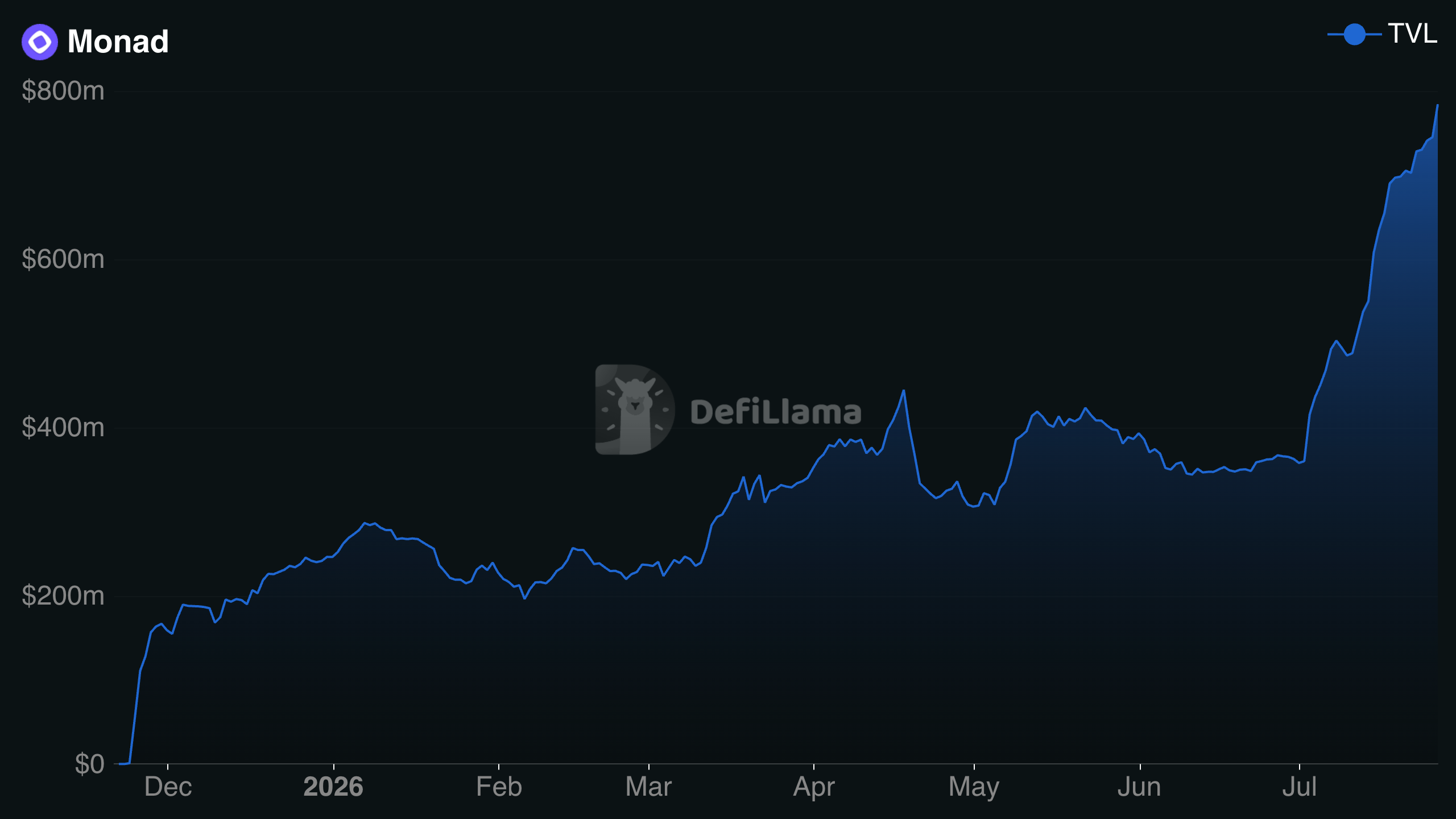
DeFi TVL is growing quickly. Source: DefiLlama.
Above the protocol layer, professional risk curators are allocating at scale. K3 Capital manages over $185 million on Monad and Hyperithm manages over $150 million. Curators exist to deploy client capital into vetted strategies, so sizable allocations from firms like these represent institutional conviction about the quality of Monad's markets. The markets they utilize are the same ones open to everyone else. An individual depositor earns in the same Aave pool, at the same rate, as the largest allocator on the network.
All of this capital does more than sit idly. The deposits earning yield in these lending markets are the same liquidity that allows users to borrow freely. Capital that is parked and earning is also capital available to trade against.
Trading: value moves and prices form
On Monad, a position opened in a lending market can be borrowed against, swapped on an exchange, or rotated into a yield-bearing asset without leaving the network, so capital that would sit idle between venues elsewhere continues to be deployed effectively.
Monad's spot markets have handled about $15 billion in trading volume, led by Uniswap and Kuru. Across all spot venues, DEX volume consistently exceeds $1 billion per month.
Perpetuals are growing faster than any other segment. Perpl's volume reached new highs of over $800 million in the last month and chain-wide perps volume reached over $350 million each of the past two weeks. Proprietary AMMs are compounding the liquidity advantage, quoting spreads tighter than centralized exchanges — the real-time pricing is visible at mpamm.wtf. Trading infrastructure that was traditionally available through specialized intermediaries is increasingly accessible to anyone onchain.
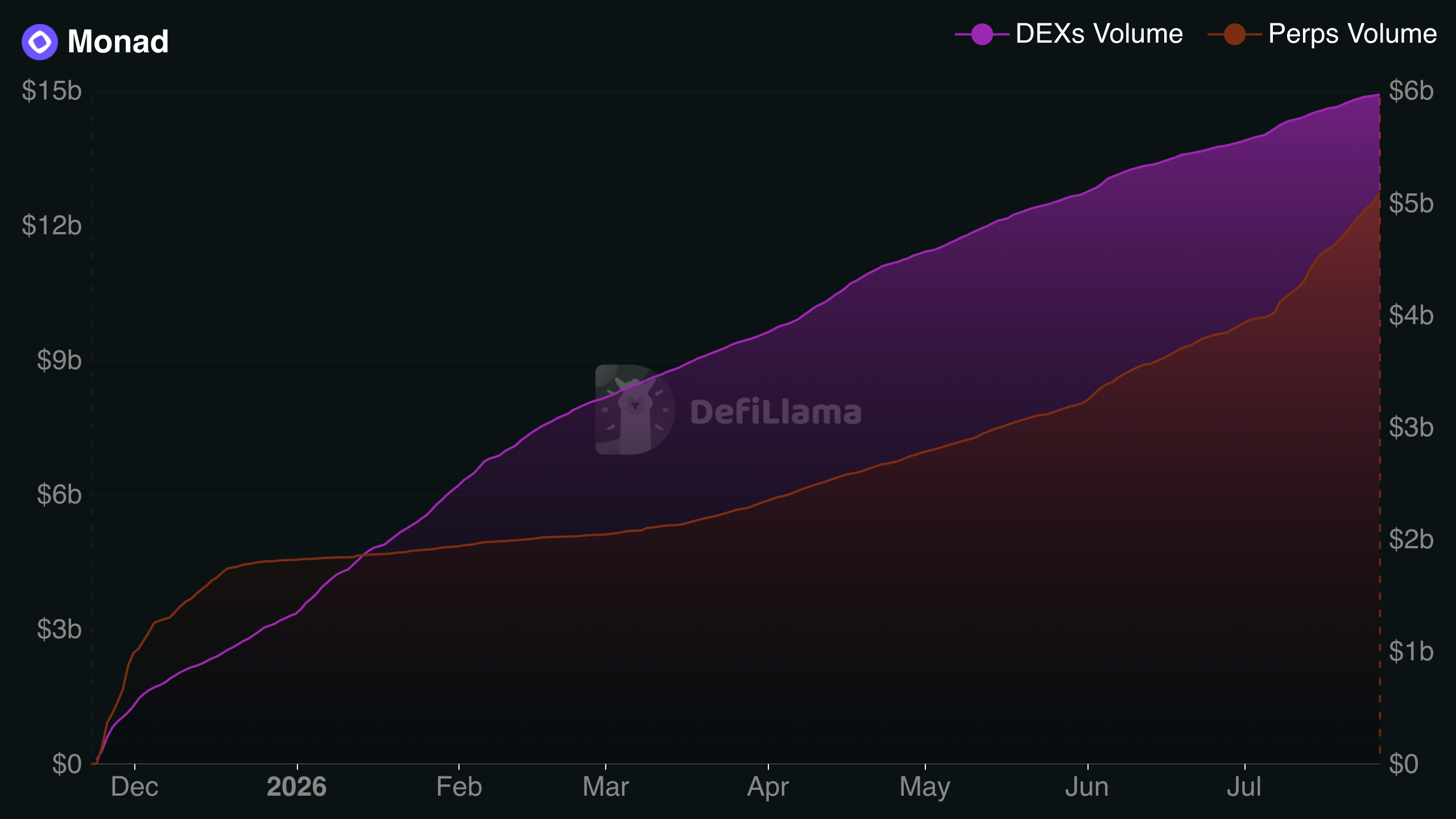
Trading volumes are reaching new highs. Source: DefiLlama.
The trading venue composition is broadening past initial primitives as well. HelloTrade announced its migration to Monad, and they plan to bring perps and spot markets for over a thousand assets. Obsidian went live, bringing early perpetual listings for many new assets with plans to bring markets to Monad that are available on no other chains.
On the predictions markets front, both Kalshi and Polymarket added support for deposits and withdrawals to their prediction markets on Monad.
Access to MON has expanded as well, with listings on Coinbase, Revolut, and Interactive Brokers, putting the network token in front of users who never need to touch an onchain venue directly.
These markets function because the liquidity beneath them is deep, and the trading activity rewards the depositors and liquidity providers who supplied that depth. Increasingly, these markets are pricing assets that originate outside crypto, tying in the global economy.
Real-world assets: the offchain economy plugs in
Tokenized real-world assets on Monad carry an active market cap of over $430 million, accounting for more than half the size of Monad's DeFi TVL. This is the third highest active DeFi Active TVL for RWAs of all chains, behind Ethereum and Solana. In previous cycles, tokenized assets sat idly in wrappers waiting for markets that never showed up. On Monad, the markets were already there when the assets arrived, allowing for efficient movement of assets and capital.
The result is that these assets are productive from day one, utilized through every layer of the economy. In payments, they back the stablecoins moving across the rails. For example, in DeFi, a private credit position from Valos, whose vault has grown past $105 million, can be posted as collateral in Morpho markets. SyrupUSDC from Maple Finance, a yield-bearing stablecoin driven by institutional loans, has over $195 million deposited in DeFi. In trading, these instruments can be swapped for any other asset freely.
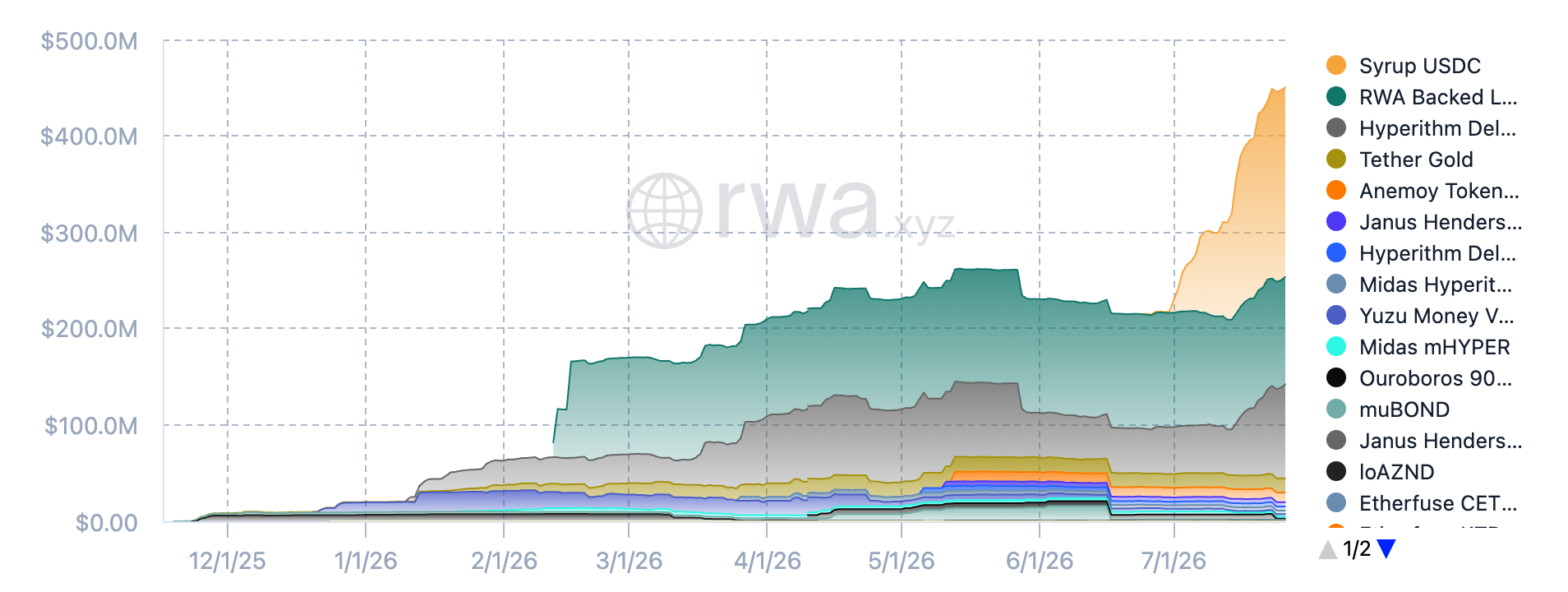
Active RWAs in DeFi are expanding. Source: rwa.xyz.
The current assets are largely institutional offerings. Centrifuge and FalconX have brought Treasuries from Janus Henderson, AAA-rated CLO tranches, Apollo's diversified credit strategy, and private credit facilities. Exposure to these assets have historically required institutional access, but are now available as transferable instruments. Other notable assets such as Tether Gold, cbBTC, and Korean Treasury Bonds are also available onchain.
An asset that arrives on Monad becomes collateral, trading inventory, and part of a yield-bearing balance sheet from the moment it lands. That productivity makes the network an economy, and the surface area keeps expanding with the people building on it.
Builders and the network: the flywheel widens
Full EVM compatibility has been doing quiet work throughout this story. It is how Aave, Morpho, and Uniswap deployed without rewriting their stacks, how Chainlink integrated with existing tooling, and why more than 150 applications shipped in eight months. Builders show up because the economy is real and the cost of plugging into it is low. No gatekeeper approves a deployment, and a two-person team plugs into the same liquidity as a public company.
The usage confirms it. The network sees over 15,000 daily active addresses and has processed more than 500 million transactions since launch.
The protocol itself is improving against real production load. The validator set has expanded to 200 globally distributed nodes and continues to grow, giving institutional users the geographic and operational diversity they require before committing production volume. Client iteration has delivered many updates, such as 300ms block times and more efficient state storage.
Category Labs has been conducting cutting-edge research on the protocol's next layer. An encrypted mempool is in the pipeline, aimed at keeping execution fair, so a transaction can't be exploited by whoever sees it first. The work is peer-reviewed: the BTX encrypted mempool paper earned Category Labs researchers a Distinguished Paper Award at the IEEE Security and Privacy conference. They also released a paper on Cadence, their multiple concurrent proposer consensus design that will dramatically improve network speeds. The combination of these two features will largely solve the problem of MEV that has plagued blockchains for years.
Simultaneously, the builder funnel is expanding the economy's surface area all around the globe. Nitro, a three-month accelerator, deploys $500,000 per team and offers hands on support. Blitz, a one-day hackathon series, has brought 2,500 developers into the ecosystem across more than 30 events. Foundry works in person with later-stage teams already in market. Together, these programs run across Asia, South America, Africa, Europe, and North America.
Every new application gives money another place to move, and every protocol improvement lets it move faster when it gets there. The growth of Monad economy will only continue to accelerate from here.
What's Next?
The economy's foundation is in place. The next phase is growth along every axis: deeper liquidity in lending markets, more assets onchain, more payment volume, and more builders shipping.
All of this is built for one mission: open access to financial markets on neutral ground. Anyone should have access to yield, credit, and markets. A business should be able to raise, borrow, and settle on the same rails as the largest institutions. With BTX integrated, transactions will stay encrypted until their ordering is fixed; by the time anyone can read your intent, it's too late to act on it. Fairness becomes a property of the system, like finality.
Monad was built to make that kind of openness fast enough and cheap enough to work at global scale, and the past eight months show what happens when it does.