How Stablecoins Are Reshaping Finance in Argentina

Monad Foundation
@monad- Published on
- · 6 min read
Summary
Argentina already has one of LATAM's most developed digital-payments markets. In September 2026 alone, Argentines made 122.8 million interoperable QR payments across 93 registered interoperable wallets. Digital dollars were also widely held and used before fintechs began expanding beyond exchange products.
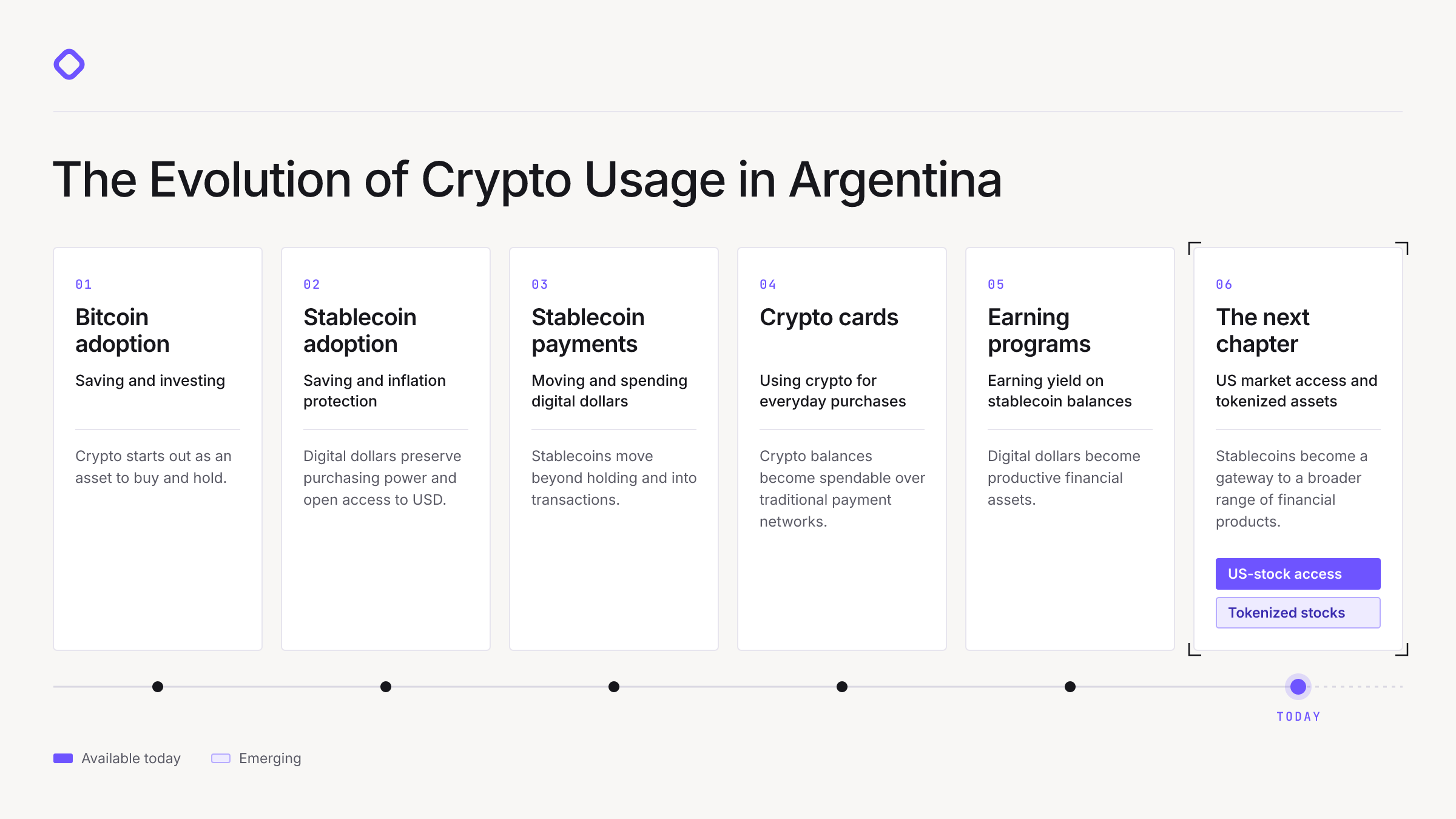
Stablecoins initially gained traction as a way to preserve savings and access dollars. Their role has since expanded into payments, yield and investment. At Lemon, the share of stablecoin volume used transactionally rose from 14% in 2024 to roughly 50% in 2026.
That foundation is supporting a broader market for onchain financial services. Consumer fintechs are adding payments and investment products, businesses are using stablecoins to move and settle money, and financial institutions are building custody and digital-asset products.
Companies across each of these segments already build on or integrate with Monad. Its low-cost, high-throughput infrastructure supports high-speed, programmable transactions, while keeping the same assets and liquidity accessible across payments, trading, lending and other financial applications.
Building financial products in Argentina?
Neobanks, wallets, exchanges and payment providers are already building on Monad.
How Lemon, Infinia and Fireblocks are expanding stablecoin use in Argentina
Lemon is turning stablecoin savings into payments and investment
Lemon launched in Argentina in 2019 as a way to buy Bitcoin and digital dollars with pesos. It has since expanded into payments, transfers, yield, foreign currencies and stocks.
Lemon has more than 4 million validated users across Latin America and processed more than $9 billion in 2025. According to Lemon, it processed more than $900 million in stablecoins in 2026, primarily in Argentina.
The share of Lemon's stablecoin volume used transactionally rose from 14% in 2024 to roughly 50% in 2026. Users can now pay through Visa and the Pix instant payment system, access lending and yield opportunities through Morpho and use stablecoins to access US stocks.
The challenge now is making all of that happen within a single experience, regardless of whether there are pesos, dollars, stablecoins or blockchain infrastructure behind each transaction.
— Ignacio Gimenez, Business Manager at Lemon
Lemon recently enabled Monad for stablecoin onramps and offramps. As customers transfer stablecoins more frequently, fees increase the cost of each transaction and settlement time determines how quickly funds become available.
Monad offers a low-cost, sub-second network for stablecoin deposits and withdrawals. Assets on Monad can also be integrated into lending, trading and other financial applications.
Infinia is moving stablecoins into cross-border business finance
Argentina has sophisticated domestic payment infrastructure, but moving money between countries still requires businesses to navigate separate banking, payment and FX systems. Companies operating across several markets may need different bank accounts, payment networks, virtual accounts and FX providers for each country.
Stablecoins provide a common settlement asset that can move across those systems, reducing the number of intermediaries required to transfer and settle money internationally.
Infinia connects local bank rails, virtual accounts, FX and stablecoins through a single infrastructure layer. Businesses can collect funds locally, convert currencies and settle money across markets without managing each connection separately. Its infrastructure spans more than 10 markets and serves companies including Stripe/Bridge, OpenFX, Kast and Despegar.
As software and APIs trigger more transactions, even small fees compound and settlement delays tie up working capital.
We chose to integrate with Monad because it can provide the speed and cost efficiency required for high-frequency, programmatic financial activity.
— Alejandro Rettig, Co-Founder & CTO at Infinia
Lower fees protect margins, while faster finality reduces the capital tied up in transit.
Our goal is to make the blockchain layer increasingly invisible to the end customer.
— Alejandro Rettig, Co-Founder & CTO at Infinia
Businesses choose the currency and payment method that fit the transaction while Infinia handles the bank rails, FX and blockchain infrastructure underneath.
Fireblocks is bringing banks and institutions onchain
Stablecoins reached Argentine consumers before banks had the custody and compliance infrastructure to offer digital-asset services at scale.
Argentina's securities regulator, the Comisión Nacional de Valores (CNV), has established a registry for crypto service providers and a sandbox for tokenized securities. Financial institutions are beginning to pilot digital-asset products, including custody, payments and tokenization.
Fireblocks gives banks the custody, transaction policies and compliance controls needed to offer products such as digital-asset custody, payments and tokenized assets while operating on public blockchains. It has supported Monad since mainnet day one and serves more than 2,000 institutional users globally.
Argentina's crypto market is no longer being shaped by demand alone. It's going through a historic institutional shift.
— Sarina Gowland, Sales Director at Fireblocks
Those controls allow institutions to access onchain assets, liquidity and applications while supporting their security and compliance requirements.
Some institutional transactions cannot be executed transparently because public settlement can expose counterparties, positions and trading strategies. Monad Private Settlement, announced in early October, is being developed by Category Labs to enable institutions to execute sensitive transactions in customizable private environments that settle on Monad L1.
This aims to preserve sensitive transaction information without compromising connectivity to shared liquidity.
On Monad, the same capital can move across financial markets
As of November 2026, nearly $600 million in stablecoins were circulating on Monad.
On a permissioned network, using an asset in a new product may require the operator to approve or build an integration. That can slow product development and fragment liquidity. On Monad, independent applications can seamlessly integrate the assets that are already on the network.
As a result, within 46 days of launch, Aave's Monad market became its third-largest deployment by weekly fees. Stablecoins and yield-bearing assets already on Monad can be used as collateral, allowing holders to borrow without moving capital to another network.
As more capital enters through payments, onramps and business settlement, developers can build on liquidity that already exists rather than bootstrap a separate pool for every product. Monad's low fees keep repeated transactions economical, while sub-second finality lets capital be reused quickly after settlement.
In Argentina, stablecoins began as a way to preserve purchasing power and access dollars. Today they increasingly support payments, cross-border transfers, yield and investment, while businesses and institutions are beginning to use digital assets for treasury, settlement and financial products.
As these uses expand, stablecoins evolve from a standalone crypto product into a common form of money across a global and interconnected financial system.
Building stablecoin or payments products? Talk to our team →