What scheduled transactions change for onchain finance

Monad Foundation
@monad- Published on
- · 6 min read
Blockchains can do more than make financial transactions faster. They can put assets and financial applications on shared, programmable infrastructure, where they work together instead of across disconnected systems. To do that, a blockchain must support the ongoing operations that financial products depend on.
Take a bond issued onchain. A smart contract defines how much interest investors receive and when each payment is due. The bond can be traded, transferred, and used across financial applications. But when a payment date arrives, something still has to tell the smart contract to pay.
Smart contracts can make financial transactions follow predefined rules, but they cannot start a transaction on their own. Right now, an account or an offchain program has to trigger them. Many applications depend on this, from trading venues to tokenized assets that need ongoing management.
Category Labs, which developed the initial client for the Monad protocol, has proposed a new capability for the Monad blockchain called scheduled transactions. With it, smart contracts could schedule future transactions onchain, so they would not need an external service to start them. This would change how teams build and run financial applications as more institutions bring assets onchain.
Why smart contracts depend on keepers
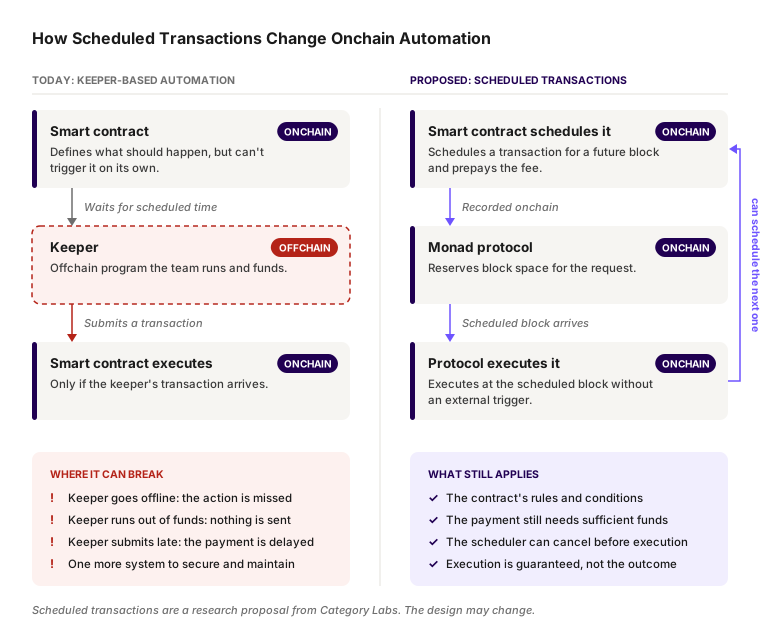
Today, most applications use external services called keepers to solve this. A keeper is a program that runs outside the blockchain and watches for when something needs to happen. When the time comes, it submits a transaction that triggers the relevant smart contract.
A perpetual futures exchange is one example. It updates funding payments at regular intervals to keep contract prices close to the underlying market. The rules for those payments can live in smart contracts, but the exchange still needs a keeper to trigger the updates.
This approach is common in DeFi, but it gives the team one more system to run. The team must make sure the keeper stays online, has enough funds to pay fees, and submits on time. If the keeper fails or is late, the payment or update it supports is late too. As more financial activity moves onchain, the blockchain could do more of this work itself.
What changes with scheduled transactions
Under Category Labs’ proposed design, a user or smart contract could schedule a transaction for a future block instead of relying on a keeper to submit it later. Monad would record that instruction onchain, with the transaction fee paid in advance. When the designated block arrives, the protocol would execute the scheduled transaction.
The design also reserves a portion of each block's capacity for scheduled transactions so accepted scheduling requests have space allocated for execution. The party that schedules a transaction can cancel it.
A smart contract could also schedule its next transaction while it executes the current one. This could support recurring payments such as standing orders, payroll, or periodic yield distributions, without requiring an external keeper to initiate each payment.
Under the proposed design, an accepted, uncanceled transaction would be guaranteed to be executed at its scheduled block, subject to the protocol's specified conditions. The protocol would not guarantee the result. A scheduled payment still needs enough funds, and the contract's own conditions still apply. Developers could build scheduling into their applications, and institutions would have fewer external systems to manage.
Where this could make a difference
| Use case | How it works today | With scheduled transactions |
|---|---|---|
| Asset servicing and distributions | A tokenized bond can define when interest payments are due, but an external service still needs to initiate each payment. | Interest payments and fund distributions could be scheduled in advance and execute according to the contract's rules and available funds. |
| Recurring payments | Standing orders, payroll, and other recurring stablecoin payments require a service to initiate each transfer. | Future and recurring transfers could be scheduled onchain, with no keeper to start each one. |
| Trading and derivatives | Trading venues rely on external services to cancel expired orders, update funding rates, and initiate settlement. | Exchanges could schedule order cancellations, periodic funding updates, and options settlement directly onchain. |
| Investment and collateral management | Investment vaults and DeFi applications often depend on keepers to trigger recurring purchases, portfolio rebalancing, and risk checks. | Purchases, rebalancing, and risk checks could run on a schedule set by the strategy's own parameters. |
| Time-bound financial agreements | If one party fails to complete an asset exchange, another transaction may be needed to return the deposited funds. | A smart contract could schedule a refund in advance, returning funds if the agreement remains incomplete at the deadline. |
Existing automation services already make many of these possible. The difference is that scheduling would be part of the Monad protocol. The rules stay in the smart contract, and the protocol starts the next transaction, so developers have less offchain infrastructure to build and run.
From performance to financial operations
Many things need to come together for institutions to move financial activity onchain. Performance is one of them, because payments and trading depend on fast execution. Institutions also need to know how transactions are ordered and executed, how sensitive data is protected, and how applications behave over time.
Alongside performance, work on Monad addresses each of these needs:
- Research into transaction ordering is focused on making execution fairer and reducing opportunities for transaction manipulation.
- Monad Private Settlement is being developed to give institutions greater confidentiality and control while preserving access to shared liquidity.
- Scheduled transactions would reduce reliance on external infrastructure to initiate future actions.
The goal is to let institutions bring more financial activity onchain with the reliability and control they need, on open, shared infrastructure.
What's next
Scheduled transactions are currently a research proposal from Category Labs. The proposed design is open for discussion, and there are still technical and implementation details to work through. The potential applications for institutional finance are broad, and they grow as more assets move onchain.
Read the Category Labs proposal to learn more about the technical design.